On High-Range Test Construction 13: Seneka, Point of View

Publisher: In-Sight Publishing
Publisher Founding: March 1, 2014
Web Domain: http://www.in-sightpublishing.com
Location: Fort Langley, Township of Langley, British Columbia, Canada
Journal: In-Sight: Independent Interview-Based Journal
Journal Founding: August 2, 2012
Frequency: Three (3) Times Per Year
Review Status: Non-Peer-Reviewed
Access: Electronic/Digital & Open Access
Fees: None (Free)
Volume Numbering: 12
Issue Numbering: 3
Section: E
Theme Type: Idea
Theme Premise: “Outliers and Outsiders”
Theme Part: 31
Formal Sub-Theme: High-Range Test Construction
Individual Publication Date: August 22, 2024
Issue Publication Date: September 1, 2024
Author(s): Scott Douglas Jacobsen
Word Count: 1,394
Image Credits: Seneka
International Standard Serial Number (ISSN): 2369-6885
*Please see the footnotes, bibliography, and citations, after the publication.*
Abstract
This interview probes Seneka’s work in the field of high-range intelligence testing, especially the Point of View test. Seneka conceives of cognitive abilities in ways that standard tests often overlook, such as lateral thinking and divergent intelligence. In this conversation, readers will learn more about Seneka’s philosophy, his contributions to the field, and the implications of his work for a more nuanced understanding of human intelligence.
Keywords: divergent intelligence, high-range matrices test, Item Response Theory, lateral thinking, Multiple Intelligences, Spatial vision, traditional intelligence measurements, traditional tests.
On High-Range Test Construction 13: Seneka, Point of View
Scott Douglas Jacobsen: Seneka, could you briefly introduce yourself and your areas of expertise?
Seneka: I think it’s accurate to call myself a polymath. I have worked and have experience in dozens of topics such as business, hypnosis, magic, art, chess, research, writing and more.
Spanish is my native language and I self-learned English by reading some books or watching online videos. Just a heads-up: my English may sound a bit “basic”.
Jacobsen: When did this interest in test construction truly come forward for you?
Seneka: It all started from a wider curiosity about the nature of intelligence and how we can understand it better.
In traditional tests, I achieved the highest scores, which made me question the limitations of these tools in measuring the complexity of human intelligence. This is where my interest in alternative evaluation methods began, allowing me to include my understanding of multiple intelligences in test design.
Jacobsen: What were the realizations about the tests earlier, and then the need to develop yours?
Seneka: Most IQ tests tend to focus specifically on certain cognitive abilities like reasoning, working memory, or crystallized knowledge. While these are definitely important and, in my opinion, accurate, they don’t show the full range of human intelligence.
Jacobsen: What was the origin and inspiration for the creation of this test – the facts and the feelings?
Seneka: The origin of my test, Point of View, comes from both research and a more personal goal. In fact, POV is just one test in a collection that evaluates different high-level intelligences. On one hand, I aim to isolate and give more importance to divergent thinking in this test so it can be evaluated. On a personal level, I believe that we don’t value the intelligence of many people because we only measure the logical or rational part.
Jacobsen: What do you mean by “evaluating divergent thinking”?
Seneka: I think Howard Gardner was very right with his theory of multiple intelligences. In fact, my idea of intelligence is similar, but with a classification of intelligences that is not connected to educational, cultural, environmental, and social factors.
Divergent intelligence is what allows a person to look at a problem from different angles. For example, an “X” might just be the letter X for someone, but for someone with high divergent intelligence, the same X could mean a mistake, a number, two lines, a cross, a destination on a map, a selected option, a chromosome, an adult content rating, a prohibition, and many more things. The POV test specifically evaluates a person’s ability to see concepts through divergent and lateral thinking. Once you find the right perspective, the logic to apply is really simple.
Jacobsen: What skills and considerations, in an overview, seem important for both the construction of test questions and making an effective schema for them?
Seneka: Creating effective questions requires the use of my own divergent intelligence. It’s important to design items that can differentiate between different levels of ability. To do this, I need to analyze the most common uses of each element and progressively move away from the more unfrequent perspectives.
Jacobsen: With Point of View, why focus on a matrix design?
Seneka: I like matrix tests because the information is contained within the problem itself. I also know that people feel more motivated to take a test when it looks interesting. The structure is very good for “misleading” the test-taker. It hides the perspective from which to approach the problem behind hundreds of possible logics that lead nowhere. With the matrix design, I can better evaluate a person’s ability to think laterally and remove the noise.
Jacobsen: What do you mean by a “high-range matrices test”?
Seneka: These are tests aimed at people who probably perform at a very high level on traditional intelligence measurements. In my test, I try to isolate and give more weight to divergent thinking over logical or rational thinking. So, it’s possible that there may be some differences between IQ (from the traditional test) and DQ (divergent quotient).
Jacobsen: As the aim is to measure divergent and lateral thinking, how does this style of matrix design differ from more traditional mainstream tests like the Raven’s Advanced Progressive Matrices?
Seneka: While tests like Raven’s Advanced Progressive Matrices focus mainly on logical-deductive reasoning, spatial vision, and pattern recognition, POV introduces elements that require lateral thinking. The design of my test intentionally includes ambiguity to push the test-taker to explore other approaches when the “logical” approach doesn’t lead to any solution.
Jacobsen: When trying to develop questions capable of tapping a deeper reservoir of ability, what is important for spatial and matrix test type of questions?
Seneka: Even though other intelligences play a role in a high-level test, the goal is to isolate divergent intelligence until it becomes the most important factor for solving the problem. In fact, the test-taker should indicate how they reached the conclusion for each item. If they managed to find the perspective from which to solve the problem, it validates their divergent intelligence, even if the answer is wrong or they made a logical mistake.
Jacobsen: Potentially, what are roadblocks test-takers tend to make in terms of thought processes and assumptions around time commitments on these tests? So, they get artificially low scores on high-range tests.
Seneka: The biggest obstacle for participants is getting stuck on the wrong perspective. I’ll give an example with an item that I developed and finally didn’t include in the final test:
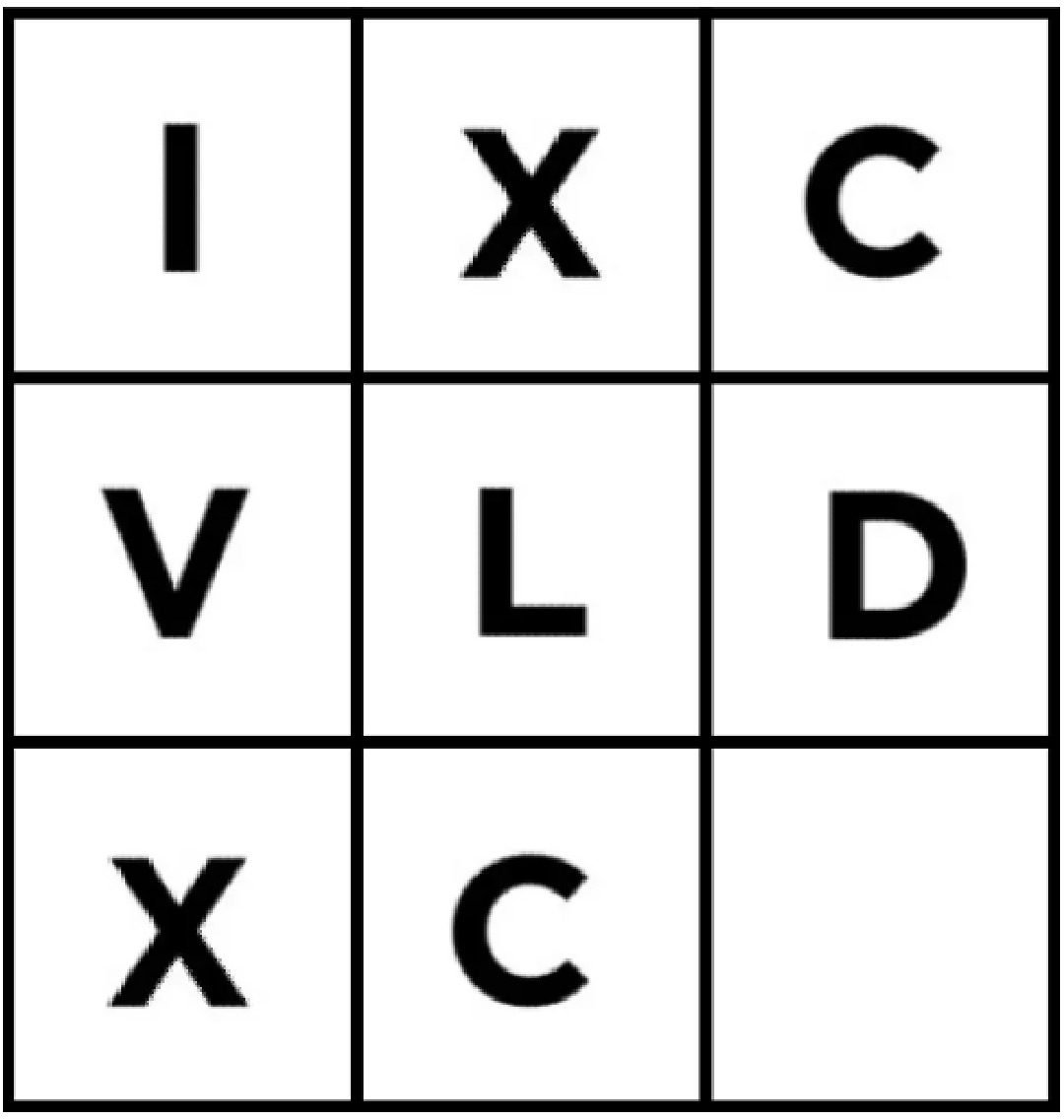
Here comes a spoiler. If you want to solve it, don’t listen to this. Many people spend minutes or even hours trying to find out what logic is hidden behind these letters: they look at their positions in the alphabet, do math operations, or search for patterns. You won’t find anything online if you search for those letters.
Only divergent intelligence allows them to “see” that the letters might not be letters and could be numbers. Once you think that, a simple search is enough to solve it. Maybe you even already know what numbers they are, and then you’ll reach the conclusion even faster.
Jacobsen: What are the difficulties in preventing cheating on tests in the online era?
Seneka: I had the task of creating original items that are not on the internet, which is quite complex, by the way. I also tested the exam with different artificial intelligences, and out of all the items, only one reached a correct conclusion. Some AIs might score between 115 and 125 on traditional tests. That’s already well above the human average. However, in lateral thinking, AIs have no chance; we humans have irreplaceable intelligences.
Jacobsen: What are the most appropriate means by which to norm a test when, in the high-range environment so far, the samples tend to be lower?
Seneka: Invite people who already belong to high IQ societies. They will be more inclined to take this test. Also, it’s important to warn that scores as low as three or four out of twenty-three are possible, even for gifted individuals. Using methods like Item Response Theory (IRT) can improve the accuracy of norms, even with smaller samples.
Jacobsen: Pragmatically speaking, for really good statistics, what is your ideal number of test-takers? You can’t say, “8,500,000,000.”
Seneka: Getting several hundred or a few hundred participants would be optimal. This number allows for relevant analysis and keeps the needed precision to identify performance differences. To give a number, reaching 500 participants would provide a solid base and statistical validity.
Jacobsen: What tests and test constructors have you considered good?
Seneka: There are few high-range test constructors, and I don’t want to argue with anyone here. In general, we could say they create harder versions of existing tests. They make tests that can be solved if you have knowledge of group theory, geometry, and mathematics at a very high level.
Recently, I discovered some tests by Laurent Dubois, and I found them very interesting.
Jacobsen: What have you learned from making a test?
Seneka: It has been a very fun experience, more art than science. And it’s helping me a lot to better define the concept of multiple intelligences, so I will continue doing this for other intelligences as well.
Jacobsen: Thank you for the opportunity and your time.
Seneka: Thank you, Scott. It’s a pleasure to discuss these topics with you.
Footnotes
None
Citations
American Medical Association (AMA 11th Edition): Jacobsen S. On High-Range Test Construction 13: Seneka, Point of View. August 2024; 12(3). http://www.in-sightpublishing.com/high-range-13
American Psychological Association (APA 7th Edition): Jacobsen, S. (2024, August 22). On High-Range Test Construction 13: Seneka, Point of View. In-Sight Publishing. 12(3).
Brazilian National Standards (ABNT): JACOBSEN, S. On High-Range Test Construction 13: Seneka, Point of View. In-Sight: Independent Interview-Based Journal, Fort Langley, v. 12, n. 3, 2024.
Chicago/Turabian, Author-Date (17th Edition): Jacobsen, Scott. 2024. “On High-Range Test Construction 13: Seneka, Point of View.” In-Sight: Independent Interview-Based Journal 12, no. 3 (Summer). http://www.in-sightpublishing.com/high-range-13.
Chicago/Turabian, Notes & Bibliography (17th Edition): Jacobsen, S “On High-Range Test Construction 13: Seneka, Point of View.” In-Sight: Independent Interview-Based Journal 12, no. 3 (August 2024).http://www.in-sightpublishing.com/high-range-13.
Harvard: Jacobsen, S. (2024) ‘On High-Range Test Construction 13: Seneka, Point of View’, In-Sight: Independent Interview-Based Journal, 12(3). <http://www.in-sightpublishing.com/high-range-13>.
Harvard (Australian): Jacobsen, S 2024, ‘On High-Range Test Construction 13: Seneka, Point of View’, In-Sight: Independent Interview-Based Journal, vol. 12, no. 3, <http://www.in-sightpublishing.com/high-range-13>.
Modern Language Association (MLA, 9th Edition): Jacobsen, Scott. “On High-Range Test Construction 13: Seneka, Point of View.” In-Sight: Independent Interview-Based Journal, vo.12, no. 3, 2024, http://www.in-sightpublishing.com/high-range-13.
Vancouver/ICMJE: Scott J. On High-Range Test Construction 13: Seneka, Point of View [Internet]. 2024 Aug; 12(3). Available from: http://www.in-sightpublishing.com/high-range-13.
License & Copyright
In-Sight Publishing by Scott Douglas Jacobsen is licensed under a Creative Commons Attribution-NonCommercial-NoDerivatives 4.0 International License. ©Scott Douglas Jacobsen and In-Sight Publishing 2012-Present. Unauthorized use or duplication of material without express permission from Scott Douglas Jacobsen strictly prohibited, excerpts and links must use full credit to Scott Douglas Jacobsen and In-Sight Publishing with direction to the original content.


