On High-Range Test Construction 21: Hindemburg Melão Jr., ‘Brazilian and Portuguese members of the most selective high IQ societies in the world’

Publisher: In-Sight Publishing
Publisher Founding: March 1, 2014
Web Domain: http://www.in-sightpublishing.com
Location: Fort Langley, Township of Langley, British Columbia, Canada
Journal: In-Sight: Independent Interview-Based Journal
Journal Founding: August 2, 2012
Frequency: Three (3) Times Per Year
Review Status: Non-Peer-Reviewed
Access: Electronic/Digital & Open Access
Fees: None (Free)
Volume Numbering: 12
Issue Numbering: 3
Section: E
Theme Type: Idea
Theme Premise: “Outliers and Outsiders”
Theme Part: 31
Formal Sub-Theme: High-Range Test Construction
Individual Publication Date: August 22, 2024
Issue Publication Date: September 1, 2024
Author(s): Hindemburg Melão Jr.
Author(s) Bio: Hindemburg Melão Jr. (January 15, 1972) was born in São Paulo, Brazil. He founded the most, or one of the most, selective high-I.Q. societies, the Sigma Society and is the Creator of the Sigma Test Extended. He is a philosopher, chess analyst, and an astrophotographer. He published hundreds of articles on chess, finance, philosophy, science, and more.
Word Count: 3,011
Image Credits: Hindemburg Melão Jr.
International Standard Serial Number (ISSN): 2369-6885
*Original publication here.*
*Translated using Google Translate.*
Please see the footnotes, bibliography, and citations, after the publication.*
Keywords: Alfred Binet and IQ tests, Challenges in measuring intelligence accurately, David Wechsler’s IQ test standardization, Early intelligence tests in ancient China, High IQ societies and their purposes, IQ test reliability vs. other scientific measurements, Sigma Society and humanitarian projects, Spearman’s g factor and general intelligence.
On High-Range Test Construction 21: Hindemburg Melão Jr., ‘Brazilian and Portuguese members of the most selective high IQ societies in the world’
English
The concept of “intelligence” is almost as old as language. Our ancestors probably first created words to represent material objects, such as stones, plants and animals, and then created words that represent feelings, processes, predicates and abstract entities. But the interval between the emergence of the first languages and the emergence of a word to represent the level of intellectual ability cannot have been very long. Although “intelligence” is such an old concept, there is still no consensus on what its exact meaning is. On the other hand, the fact that we do not know how to determine exactly and completely what intelligence is does not prevent us from studying it, exercising it and even measuring it. For example: we don’t know exactly what an orange is. If we had to describe an orange to an alien who had never come to Earth, this difficulty would be evident, because an orange is not exactly a sphere, the sour and sweet flavors would be very difficult to explain, not to mention that perhaps the aliens didn’t even have taste buds, eyes and other sensory organs similar to ours. The predominant color reflected by orange, when illuminated by solar rays or artificial light, with a spectral distribution similar to the spectral distribution of the Sun, with a peak close to the wavelength of 589 nm, would not be the same and would not even be similar if orange was illuminated by the light of a star of another spectral class, where such an alien lived. Perhaps orange was not even visible to them, even if they had eyes or organs equivalent to eyes, but with cones and rods sensitive to a different range of visible light. It would be unlikely that they would have eyes with sensitivity to a range other than visible light because almost all other stars emit much of their light in the visible range, although this is a narrow range, it appears to be predominant in the known Universe. However, although it was unlikely, we could not rule out this hypothesis. Perhaps it would even be easier to explain to this E.T. what intelligence is, from our perspective, than to explain what an orange is, because the concept of “general intelligence” or Spearman’s g factor is probably something more universal than an orange. E.T. would probably never have seen an orange, but if he had a sophisticated language to communicate, he would have intelligence and would have his own interpretation of the concept “intelligence”, so he would only need to identify some key points of our explanation to associate with the concept that he himself would have of “intelligence”.
Although we don’t know exactly what an orange is, we can measure its perimeter, its mass, determine its color, its acidity, we can distinguish an orange from a chair or a lake. Therefore, even without knowing exactly what intelligence is, we can distinguish reasonably well what intelligent behavior is and we can rank different levels of intelligence: a mouse is more intelligent than a bacteria, an elephant is more intelligent than a mouse, a human is smarter than an elephant. However, comparisons become more difficult when the differences are narrower. It is not easy to determine whether a dog is more intelligent than a cat or vice versa, whether a gorilla is more intelligent than an elephant or a dolphin, whether a horse is more intelligent than another horse. But this subjective difficulty can be resolved when objective methods of analysis are introduced. Looking at two people with similar bodies, it is difficult to know which one is heavier, but using an appropriate measuring instrument — a scale –, this information can be obtained. If the weight difference is very small, less than 1%, the scale may not be sufficient either, depending on its precision, accuracy, repeatability and some extrinsic factors, such as variations in air density, with consequent variations in thrust. , the tidal effect at the moment each one is weighed, among other factors. Furthermore, the mass of people varies over time, due to perspiration, evacuation, feeding, the density of people varies when their lungs are full or empty. As a consequence, two people with similar weights could have different weights if measured on different days or at different times, to the point that sometimes one of them could be heavier, other times lighter.
In the case of intelligence, the situation is similar in several aspects. We don’t know exactly what intelligence is, but we have a very reasonable idea of what it is and what it isn’t. Intelligence cannot be confused with rabbits, nor with holes. At a more refined level of distinction, intelligence cannot be confused with perfume or beauty. At an even more refined level, intelligence cannot be confused with memory or culture, however, when this level of similarity is reached, memory and culture begin to appear sufficiently similar to intelligence for them to interfere with it, or at least interfere with results of the measurements that are attempted to be made of intelligence, “contaminating” these results, so to speak. Depending on the interpretation made, it can be said that memory and culture are components of intelligence, especially working memory, which is the ability to simultaneously manage large volumes of data.
Aware of these difficulties and limitations, we can now talk a little about measuring intelligence. Correctly standardized IQ tests are the psychological instruments that most rigorously and diligently follow all the protocols of the scientific method. As a result, diagnoses based on IQ tests are more reliable than any other diagnosis carried out in Psychology.
A fact that few know is that IQ tests produce more accurate results than the methods used to calculate the distances of galaxies, or the methods used to calculate the masses of some subatomic particles (quarks, neutrinos, etc.), or the methods for loss risk calculations carried out by most large banks. They are even much more accurate than the accident risk estimates made by NASA, as demonstrated by Nobel laureate in Physics Richard Feynman, during the investigation of the Challenger space shuttle accident in 1986.
This does not mean that IQ tests are flawless. They are not. But if compared to other measuring instruments used in Physics, Chemistry, Meteorology, Astronomy, Econometrics, Sociology, Anthropology, Medicine and Education, the reliability in the results produced by IQ tests is above the average of the instruments used in these areas, including more reliable than most laboratory tests that doctors rely on to assess people’s health status. Anyone interested in delving deeper into this topic can read my book “IMCH – a mathematical analysis of errors in the BMI formula”. The book does not just deal with BMI, but with various scientific topics, points out some problems in large international databases used in Medicine, and presents a new formula for calculating BMI, more accurate and better founded than the traditional one.
The first recorded intelligence tests began to be used in China, around 3,000 BC, but at that time practically nothing was known about statistics or the scientific method, so those tests were not standardized nor did they follow the adopted protocols. in modern tests. These protocols serve to ensure that the variable measured by the test is in fact strongly correlated with intelligence, to ensure that all test items measure approximately the same variable, to ensure that the scores obtained on two random halves of the test are similar, to ensure that the same test administered a few days or months later produces results similar to those of the first administration, to ensure that different tests designed to measure general intelligence produce similar results for the majority of people tested. There is a list of precautions that are taken in the process of constructing a good IQ test, to ensure that the scores produced are good representations of what it is intended to measure.
Furthermore, the theoretical basis on which IQ tests were designed is solidly supported by the scientific method, more than any other construct in Psychology. The creator of the first IQ tests, Alfred Binet, started from the premise that human intelligence increases with age, at least between birth and adulthood. He then designed questionnaires with questions in which he tried to minimize the requirement for specialized knowledge and prioritize the use of logical reasoning, as free as possible from cultural factors. These questionnaires were administered to large groups of children, adolescents and adults of different age groups. Then he compared the number of correct answers with age, and confirmed his hypothesis that the number of correct answers increased with age. On average, 8-year-old children got more questions correct than the average 7-year-old child; while the average of the 9-year-olds was more correct than the average of the 8-year-olds, and so on, up to around 16 years. From the age of 16 onwards, there seemed to be no increase in the number of correct answers depending on age. In more comprehensive research carried out in the following years, it was found that perhaps this limit was at 17 years old, in some cases reaching 19 or 20 years old, but the growth curve was not linear, and when it approached 16, the person had already came very close to their maximum level of mental development, with little evolution in the following years and decades.
Binet also noted that although the average 12-year-old child was much more correct than the average 8-year-old, there were some 8-year-olds who were more correct than the average of 9-, 10-, 11- and even 12-year-olds. The opposite also happened, that is, some 12-year-olds got less correct answers than the average of the 8-year-olds. With this, the concept of “mental levels” emerged, which later received the name “mental age” and finally received the name “intelligence quotient”, abbreviated to “IQ” or “IQ”. This is how the term “IQ” began to be used to represent the proportion between mental age and chronological age. An 8 year old child with a mental age of 12 would have an IQ = 100×12/8 = 150. Applying the same formula, an 8 year old child aged 14 would have an IQ of 175. Above 16 years old it no longer makes much sense to talk about age mental, because people aged 40 and 16 get approximately the same number of questions right.
When these high IQ children became adults, you could give them tests and see how many they got right, so you could assign IQ scores to adults as well, based on the IQ that had been measured for these people while they were still growing up. children, assuming that they continued to develop intellectually at the same rate as the average of other children and assuming that evolution was approximately linear. These are two reasonable premises, they are not exactly correct, but they are close to reality, as verified in studies carried out in the following decades.
Another point that needs to be clarified is what Binet’s motivation was for creating these tests. A very common problem in French schools at that time, as in schools in all countries at all times, is that teachers often sympathized more with some students than others, and tended to favor their favorite students with higher grades. In a period when racism was much more serious than it is today, this was a big problem, because in all subjective assessments teachers tended to harm students they didn’t like, and often the reason they didn’t like them was simply because student appearance. The problem was not always racism. The teacher could simply not like the student’s appearance, or the teacher could be anti-Semitic, or he could be misogynistic, among other reasons. This is how Einstein was considered retarded by one of his teachers, and Thomas Edison was also undervalued by his teachers, this is how Henrietta Leavitt, Cecilia Payne and other women were undervalued and their merits were not properly recognized.
Faced with this problem, Binet decided to create assessment instruments that could objectively measure children’s intellectual performance, to prevent them from being treated unfairly and abusively by their teachers. Unfortunately, IQ tests are not enough to prevent all abuse, nor can they prevent offensive comments against students who are less privileged intellectually or economically, nor can they prevent the physical and verbal aggression that teachers used to practice against students. IQ tests only served to alleviate part of the problems that existed at the time, and it wasn’t a small part, because it was common for very intelligent and introverted children to be placed in rooms for the disabled, because they didn’t communicate much, and that caused irreparable damage not only to these children, but to society as a whole, since if they had adequate opportunities to develop they could contribute to curing diseases, solving social, technological and many other problems.
A question that also needs to be clarified is: shouldn’t opportunities be offered to all children, instead of just the most intelligent ones? And the answer is very simple: yes, but good opportunities for everyone does not mean equal opportunities for everyone. Some children do not want to and would not take advantage of an “opportunity” to learn Comprehensive Calculus, while others would not take advantage of or be interested in learning to play the harp, others would not be interested in learning how to build wooden tables, etc. What is considered an “opportunity” for some may be a “punishment” for others.
Continuing Binet’s work, in the 1930s, David Wechsler started using a different method for standardizing scores, based on the level of rarity of people achieving a certain number of correct answers. With this, it solved some distortions and some problems that were being observed in the old method, but this solution introduced new distortions. Our purpose is not to deepen the analysis of the history of IQ tests nor to critically analyze the quality of the methods used to measure intelligence or the evolution of these methods over time, but only to briefly introduce these topics. Therefore, anyone interested in a more detailed analysis can access this link:
https://www.sigmasociety.net/artigos
At the end of the 1990s, with the popularization of the Internet, people with IQs well above average, who until then lived relatively isolated, as there were few people geographically close to them with whom they shared common interests, took advantage of this opportunity generated by globalization to create communities designed to meet the needs and interests of people with these different intellectual profiles. Until then, there were only 15 high IQ societies in the world, almost all of them founded in the United States, except Sigma Society, which was founded in Brazil:
Mensa, founded in 1946
Intertel, founded in 1966
ISPE, founded in 1974
TNS, founded in 1978
Mega, founded in 1982 (registered in the 1990 Guinness Book as the most exclusive high IQ society in the world)
Prometheus, founded in 1982
TOPS, founded in 1989
OATH, founded in 1992
IQuadrivium, founded in 1992
Giga, founded in 1996
Glia, founded in 1997
Colloquy, founded in 1998
Sigma, founded in 1999
Sigma VI, founded in 1999
Pi Society, founded in 1999
In the following years, several others were created, exceeding 100 societies for people with high IQ, of which around 70 are currently active. The proposals varied greatly from one to another. Sigma Society’s proposals were these (in the image below):
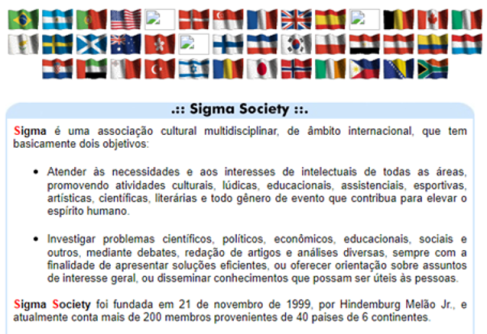
The High IQ Society for Humanity, for example, was created in Denmark by David Udbjorg to help needy children in Africa, where he lived for more than 10 years, providing these children with access to Education and some technological resources, which give them it offered slightly better prospects for growing socially and culturally. Unfortunately, the High IQ Society for Humanity closed its activities due to lack of resources.
During the period in which High IQ Society for Humanity was in operation, I dedicated a considerable amount of time to this entity’s projects and made dozens of donations (all membership fees from Platinum Society, of which I was president and founder, went to HIQSH). Furthermore, through Sigma Society, I organized assistance projects for the victims of the tsunami in Indonesia in 2004, the victims of the landslides in Santa Catarina and Itajaí in 2007 and 2008, I contributed to the dissemination of the CliqueFome project, with the promotion of painters with the mouth and with the feet (people who do not have both arms) etc., in addition to individual projects, carried out outside the entity. Sigma Society offered free courses in Astronomy, Chess, Latin and Sanskrit, in addition to more than 1000 articles on various educational, scientific, philosophical and cultural topics.
In my opinion, and in the opinions of many friends and colleagues in the mainstream high IQ communities, intelligence is not an attribute to boast about. It is a divine gift that brings with it a high dose of responsibility and must be used wisely. That’s why I try to channel my potential to solve relevant problems in different areas. Sometimes I can’t get concrete results. Other times I get good results, like my world record recorded in the Guinness Book 1998, or the innovation I present in my book “IMCH – analysis of mathematical errors in the BMI formula”, in which I bring to light a solution to a problem that it had been incorrectly addressed for over 180 years and was harming over 390 million people. I am the author of a new metric for investment risk that was considered superior to the metrics of William Sharpe (Nobel in 1990) and Franco Modigliani (Nobel in 1985), according to an assessment published in the most reputable magazine in Brazil in this area. Here is a list of some of my contributions:
https://www.sigmasociety.net/hm
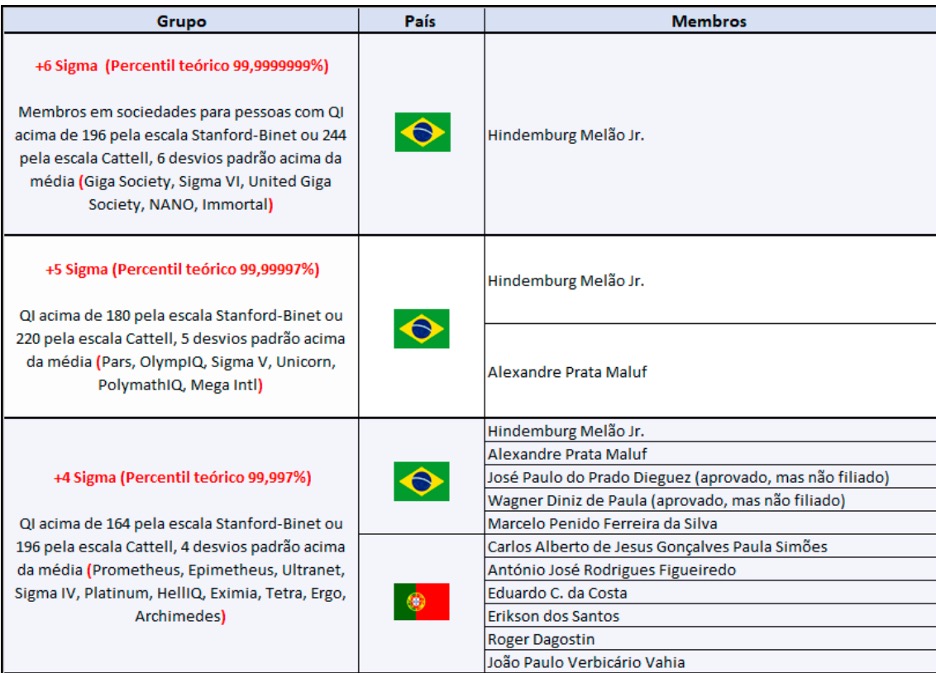
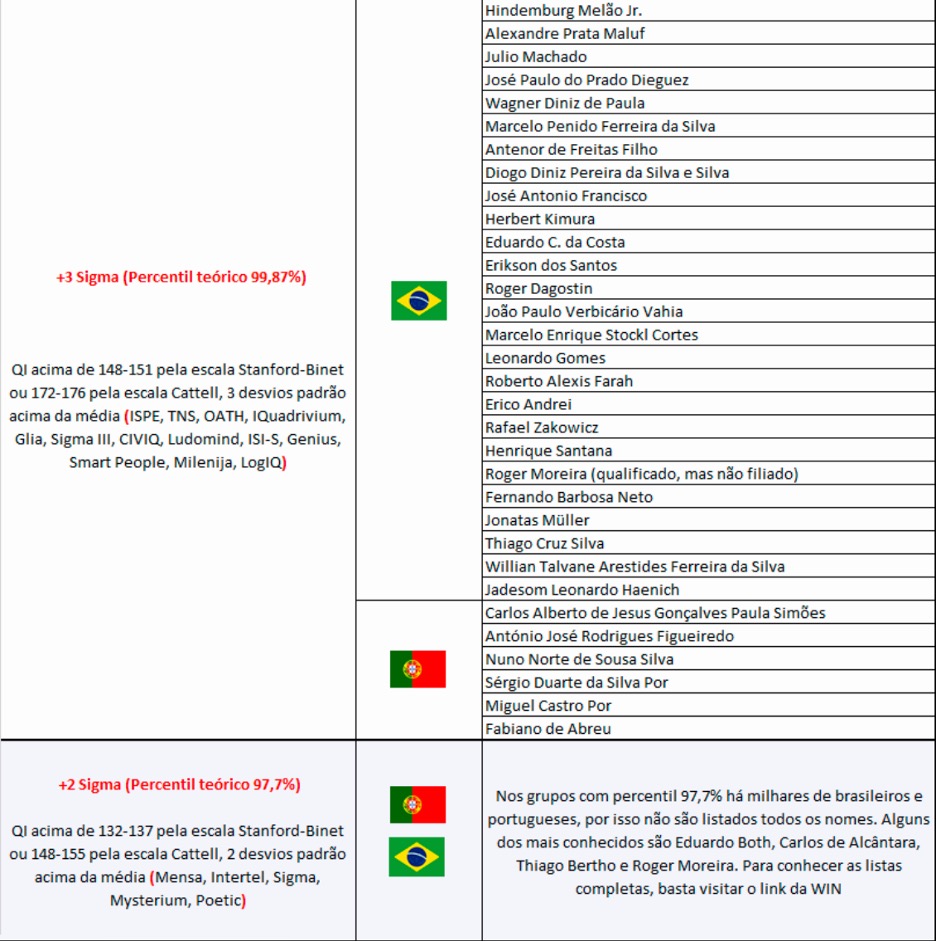
Some friends and colleagues from high-IQ communities are also active in intellectual production and engagement in social, environmental, and educational issues. Below, I present a list of Brazilian and Portuguese members in some of the main societies for people with high IQ. Many of them also work for the common good and harmony between people.
Portugues
O conceito de “inteligência” é quase tão antigo quanto a linguagem. Provavelmente nossos ancestrais criaram primeiramente palavras para representar objetos materiais, como pedras, plantas e animais, para depois criar palavras que representam sentimentos, processos, predicados e entidades abstratas. Mas o intervalo entre o surgimento das primeiras linguagens e o surgimento de uma palavra para representar o nível de habilidade intelectual não deve ter sido muito longo.
Apesar de “inteligência” ser um conceito tão antigo, continua não havendo consenso sobre qual é seu significado exato. Por outro lado, o fato de não sabermos determinar exatamente e completamente o que é a inteligência não nos impede de estudá-la, exercitá-la e até mesmo medi-la.
Por exemplo: não se sabe exatamente o que é uma laranja. Se tivéssemos que descrever uma laranja para um alienígena que nunca tivesse vindo à Terra, essa dificuldade ficaria evidente, porque uma laranja não é exatamente uma esfera, os sabores azedo e doce seriam dificílimos de explicar, sem contar que talvez os alienígenas nem tivessem paladar, olhos e outros órgãos sensoriais similares aos nossos. A cor predominante refletida pela laranja, quando iluminada por raios solares ou por luz artificial, com distribuição espectral similar à distribuição espectral do Sol, com pico perto do comprimento de onda de 589 nm, não seria a mesma e nem sequer seria semelhante se a laranja fosse iluminada pela luz de uma estrela de outra classe espectral, onde morasse tal alienígena. Talvez a laranja nem sequer fosse visível para eles, ainda que eles possuíssem olhos ou órgãos equivalentes aos olhos, mas com cones e bastonetes sensíveis a um intervalo diferente da luz visível. Seria improvável que tivessem olhos com sensibilidade numa faixa diferente da luz visível porque quase todas as outras estrelas emitem boa parte de sua luz na faixa visível, pois embora essa seja uma faixa estreita, parece ser predominante no Universo conhecido. Contudo, embora fosse improvável, não poderíamos descartar essa hipótese. Talvez fosse até mais fácil explicar a esse E.T. o que é inteligência, sob nossa perspectiva, do que explicar o que é uma laranja, porque o conceito de “inteligência geral” ou fator g de Spearman é provavelmente algo mais universal do que uma laranja. Provavelmente o E.T. nunca teria visto uma laranja, mas se ele tivesse uma linguagem sofisticada para se comunicar, ele teria inteligência e teria sua própria interpretação do conceito “inteligência”, logo ele só precisaria identificar alguns pontos-chave de nossa explicação para associar com o conceito que ele próprio teria de “inteligência”.
Embora não saibamos exatamente o que é uma laranja, podemos medir seu perímetro, sua massa, determinar sua cor, sua acidez, conseguimos distinguir uma laranja de uma cadeira ou de um lago. Portanto, mesmo sem que saibamos exatamente o que é inteligência, conseguimos distinguir razoavelmente bem o que é um comportamento inteligente e conseguimos ranquear diferentes níveis de inteligência: um rato é mais inteligente que uma bactéria, um elefante é mais inteligente que um rato, um humano é mais inteligente que um elefante. Entretanto as comparações ficam mais difíceis quando as diferenças são mais estreitas. Não é fácil determinar se um cachorro é mais inteligente que um gato ou vice-versa, se um gorila é mais inteligente que um elefante ou que um golfinho, se um cavalo é mais inteligente que outro cavalo. Mas essa dificuldade subjetiva pode ser resolvida quando se introduz métodos objetivos de análise. Olhando para duas pessoas com corpos semelhantes, é difícil saber qual dela é a mais pesada, mas utilizando um instrumento de medida apropriado — uma balança –, pode-se obter essa informação. Se a diferença de peso for muito pequena, menor que 1%, talvez a balança também não seja suficiente, dependendo de sua precisão, sua acurácia, sua repetibilidade e de alguns fatores extrínsecos, como variações na densidade do ar, com consequentes variações no empuxo, o efeito de maré no instante que cada uma delas for pesada, entre outros fatores. Além disso, a massa das pessoas varia ao longo do tempo, por transpiração, evacuação, alimentação, a densidade das pessoas varia quando estão com os pulmões cheios ou vazios. Como consequência, duas pessoas com pesos semelhantes poderiam ter pesos diferentes se medidos em dias diferentes ou em horários diferentes, a tal ponto que algumas vezes uma delas poderia ser mais pesada, outras vezes mais leve.
No caso da inteligência, a situação é semelhante sob vários aspectos. Não se sabe exatamente o que é a inteligência, mas se tem uma ideia bastante razoável do que ela é e do que ela não é. Não se confunde inteligência com coelhos, nem com buracos. Num nível mais refinado de distinção, não se confunde inteligência com perfume nem com beleza. Num nível ainda mais refinado, não se confunde inteligência com memória nem com cultura, entretanto, quando se chega nesse nível de similaridade, a memória e a cultura já começam a se mostrar suficientemente semelhantes à inteligência para que interfiram nela, ou pelo menos interfiram nos resultados das medidas que se tenta fazer da inteligência, “contaminando” esses resultados, por assim dizer. Dependendo da interpretação que se faça, pode-se dizer que a memória e a cultura são componentes da inteligência, especialmente a memória de trabalho, que é a capacidade de administrar simultaneamente grandes volumes de dados.
Cientes dessas dificuldades e limitações, podemos agora falar um pouco sobre medida da inteligência. Os testes de QI corretamente normatizados são os instrumentos psicológicos que seguem com mais rigor e diligência todos os protocolos do método científico. Como resultado disso, os diagnósticos baseados em testes de QI são mais confiáveis do que qualquer outro diagnóstico realizado em Psicologia.
Um fato que poucos sabem é que os testes de QI produzem resultados mais acurados do que os métodos utilizados para cálculo das distâncias de galáxias, ou os métodos usados para calcular as massas de algumas partículas subatômicas (quarks, neutrinos etc.), ou os métodos para cálculos de riscos de prejuízo realizados pela maioria dos grandes bancos. São inclusive muitíssimo mais acurados que as estimativas de risco de acidente feitas pela NASA, conforme demonstrou o Nobel de Física Richard Feynman, durante a investigação do acidente do ônibus espacial Challenger, em 1986.
Isso não significa que os testes de QI estejam livres de falhas. Não estão. Mas se comparados a outros instrumentos de medida utilizados em Física, Química, Meteorologia, Astronomia, Econometria, Sociologia, Antropologia, Medicina e Educação, a confiabilidade nos resultados produzidos pelos testes de QI fica acima da média da dos instrumentos utilizados nessas áreas, inclusive são mais confiáveis que a maioria dos exames laboratoriais nos quais os médicos se baseiam para avaliar o estado de saúde das pessoas. Quem tiver interesse em se aprofundar nesse tema, pode ler meu livro “IMCH – uma análise matemática dos erros na fórmula de IMC”. O livro não trata apenas de IMC, mas de vários tópicos científicos, aponta alguns problemas em grandes bancos de dados internacionais utilizados em Medicina, e apresenta uma nova fórmula para cálculo de IMC, mais acurada e mais bem fundamentada que a tradicional.
Os primeiros testes de inteligência de que se tem registro começaram a ser usados na China, por volta de 3.000 a.C., mas naquela época não se conhecia praticamente nada de Estatística nem de método científico, por isso aqueles testes não eram normatizados nem seguiam os protocolos adotados nos testes modernos. Esses protocolos servem para assegurar que a variável medida pelo teste seja de fato fortemente correlacionada com a inteligência, para assegurar que todos os itens do teste medem aproximadamente a mesma variável, para assegurar que os escores obtidos em duas metades aleatórias do teste sejam semelhantes, para assegurar que o mesmo teste aplicado alguns dias ou meses depois produza resultados semelhantes aos da primeira aplicação, para assegurar que testes diferentes destinados a medir a inteligência geral produzem resultados semelhantes para a maioria das pessoas examinadas. Há uma lista de cuidados que são tomados no processo de construção de um bom teste de QI, para garantir que os escores produzidos sejam boas representações daquilo que se pretende medir.
Além disso, a base teórica sobre a qual os testes de QI foram concebidos é solidamente amparada no método científico, mais do que qualquer outro constructo da Psicologia. O criador dos primeiros testes de QI, Alfred Binet, partiu da premissa que a inteligência humana aumenta com a idade, pelo menos entre o nascimento e a idade adulta. Em seguida, ele elaborou questionários com perguntas nas quais tentou minimizar a exigência de conhecimentos especializados e priorizar o uso do raciocínio lógico, tão livre quanto possível de fatores culturais. Esses questionários foram aplicados a grandes grupos de crianças, adolescentes e adultos de diferentes faixas etárias. Depois comparou o número de respostas certas com as idades, e confirmou sua hipótese de que o número de acertos aumentava com a idade. Em média, as crianças de 8 anos acertavam mais questões que a média das crianças de 7 anos; enquanto a média das de 9 anos acertava mais que a média das de 8 anos e assim por diante, até cerca de 16 anos. A partir de 16 anos parecia não haver mais aumento no número de acertos em função da idade. Em pesquisas mais abrangentes realizadas nos anos seguintes, verificou-se que talvez esse limite fosse aos 17 anos, em alguns casos chegando aos 19 ou 20 anos, mas a curva de crescimento não era linear, e quando beirava aos 16, a pessoa já havia chegado bem perto de seu nível máximo de desenvolvimento mental, com pouca evolução nos anos e décadas seguintes.
Binet notou também que embora a média das crianças de 12 anos acertasse muito mais que a média das de 8 anos, havia algumas crianças de 8 anos que acertavam mais que a média das crianças de 9, 10, 11 e até 12 anos. Também acontecia o contrário, isto é, algumas de 12 anos acertavam menos que a média das de 8 anos. Com isso, surgiu o conceito de “níveis mentais”, que depois recebeu o nome de “idade mental” e finalmente recebeu o nome de “quociente de inteligência”, abreviado para “QI” ou “Q.I.”. Foi assim que o termo “QI” começou a ser utilizado para representar a proporção entre a idade mental e a idade cronológica. Uma criança de 8 anos com idade mental de 12 anos teria QI = 100×12/8 = 150. Aplicando a mesma fórmula, uma criança de 8 anos com idade de 14 teria QI 175. Acima de 16 anos já não faz muito sentido falar em idade mental, porque pessoas com 40 anos e 16 anos acertam aproximadamente mesmo número de questões.
Quando essas crianças com QI elevado se tornavam adultas, podia-a aplicar testes a elas e verificar quantas elas acertavam, assim podia-se atribuir escores de QI para adultos também, com base no QI que havia sido medido para essas pessoas enquanto elas ainda eram crianças, assumindo que elas continuaram se desenvolvendo intelectualmente no mesmo ritmo da média das outras crianças e assumindo que a evolução fosse aproximadamente linear. São duas premissas razoáveis, não são exatamente corretas, mas estão próximas da realidade, conforme se verificou em estudos realizados nas décadas seguintes.
Outro ponto que precisa ser esclarecido é qual foi a motivação de Binet para criar esses testes. Um problema muito comum nas escolas francesas daquela época, assim como nas escolas de todos os países de todas as épocas, é que frequentemente os professores simpatizavam mais com alguns alunos do que com outros, e tendiam a privilegiar seus alunos favoritos com notas mais altas. Num período no qual o racismo era muito mais grave do que é hoje, esse era um grande problema, porque em todas as avaliações subjetivas os professores costumavam prejudicar os alunos dos quais eles não gostavam, e frequentemente o motivo pelo qual não gostavam era simplesmente a aparência do aluno. Nem sempre o problema era o racismo. O professor podia simplesmente não gostar da fisionomia do aluno, ou o professor podia ser antissemita, ou podia ser misógino, entre outros motivos. Foi assim que Einstein foi considerado retardado por um de seus professores, e Thomas Edison também foi subavaliado por seus professores, foi assim que Henrietta Leavitt, Cecilia Payne e outras mulheres foram subavaliadas e seus méritos não foram devidamente reconhecidos.
Diante desse problema, Binet decidiu criar instrumentos de avaliação que pudessem medir objetivamente o desempenho intelectual das crianças, para evitar que fossem tratadas de forma injusta e abusiva por seus professores. Infelizmente os testes de QI não são suficientes para evitar todos os abusos, nem podem impedir comentários ofensivos contra alunos menos privilegiados intelectualmente ou economicamente, nem evitar as agressões físicas e verbais que os professores costumavam praticar contra os alunos. Os testes de QI serviam apenas para aliviar uma parte dos problemas que existiam na época, e não era uma parte pequena, porque era comum crianças muito inteligentes e introvertidas serem colocadas em salas para deficientes, pelo fato de elas não se comunicarem muito, e isso causava danos irreparáveis não apenas para essas crianças, mas para a sociedade como um todo, já que se elas tivessem oportunidades adequadas para se desenvolver poderiam contribuir para a cura de doenças, para soluções de problemas sociais, tecnológicos e muitos outros.
Uma questão que também precisa ser esclarecida é: mas não deveriam ser oferecidas oportunidades a todas as crianças, em vez de oferecer só às mais inteligentes? E a resposta é muito simples: sim, mas oportunidades boas para todos não significa oportunidades iguais para todos. Algumas crianças não querem nem tirariam proveito de uma “oportunidade” para aprender Cálculo Integral, enquanto outras não aproveitariam nem teriam interesse em aprender a tocar harpa, outras não teriam interesse em aprender a construir mesas de madeira etc. O que é considerado “oportunidade” para alguns pode ser um “castigo” para outras.
Dando continuidade aos trabalhos de Binet, nos anos 1930, David Wechsler passou a utilizar um método diferente para padronização dos escores, com base no nível de raridade de pessoas que alcançavam determinado número de acertos. Com isso, solucionou algumas distorções e alguns problemas que estavam sendo observados no método antigo, porém essa solução introduzia novas distorções. Não é nosso propósito aprofundar a análise da história dos testes de QI nem analisar criticamente a qualidade dos métodos utilizados na aferição da inteligência ou a evolução desses métodos ao longo do tempo, mas apenas introduzir brevemente esses temas. Por isso quem tiver interesse numa análise mais detalhada poderá acessar esse link
https://www.sigmasociety.net/artigo
No final dos anos 1990, com a popularização da Internet, as pessoas com QI muito acima da média, que até então viviam relativamente isoladas, por haver poucas pessoas geograficamente próximas com as quais compartilhassem interesses comuns, aproveitaram-se dessa oportunidade gerada pela globalização para criar comunidades destinadas a atender às necessidades e aos interesses de pessoas com esses perfis intelectuais diferenciados. Até então, havia apenas 15 sociedades de elevado QI no mundo, quase todas fundadas nos Estados Unidos, exceto Sigma Society, que foi fundada no Brasil:
Mensa, fundada em 1946
Intertel, fundada em 1966
ISPE, fundada em 1974
TNS, fundada em 1978
Mega, fundada em 1982 (registrada no Guinness Book de 1990 como a sociedade de elevado QI mais exclusiva do mundo)
Prometheus, fundada em 1982
TOPS, fundada em 1989
OATH, fundada em 1992
IQuadrivium, fundada em 1992
Giga, fundada em 1996
Glia, fundada em 1997
Colloquy, fundada em 1998
Sigma, fundada em 1999
Sigma VI, fundada em 1999
Pi Society, fundada em 1999
Nos anos seguintes, foram criadas várias outras, ultrapassando 100 sociedades para pessoas de elevado QI, das quais cerca de 70 estão atualmente ativas. As propostas variavam muito de uma para outra. As propostas de Sigma Society eram estas (da imagem abaixo):
A High IQ Society for Humanity, por exemplo, foi criada na Dinamarca por David Udbjorg para ajudar crianças carentes da África, onde ele passou a morar durante mais de 10 anos, proporcionando a essas crianças acesso à Educação e a alguns recursos tecnológicos, que lhes oferecia perspectivas um pouco melhores para crescer socialmente e culturalmente. Infelizmente a High IQ Society for Humanity encerrou suas atividades por falta de recursos.
Durante o período em que High IQ Society for Humanity esteve em atividade, dediquei um tempo considerável aos projetos dessa entidade e fiz dezenas de doações (todas as taxas de filiação de Platinum Society, da qual fui presidente e fundador, eram direcionadas à HIQSH). Além disso, por meio de Sigma Society, organizei projetos de assistência às vítimas do tsunami na Indonésia em 2004, às vítimas dos desabamentos em Santa Catarina e Itajaí em 2007 e 2008, contribuí com a divulgação do projeto CliqueFome, com a divulgação dos pintores com a boca e com os pés (pessoas que não possuem os dois braços) etc., além de projetos individuais, realizados fora da entidade. Em Sigma Society foram oferecidos cursos gratuitos de Astronomia, Xadrez, Latim e Sânscrito, além de mais de 1000 artigos sobre diversos temas educacionais, científicos, filosóficos e culturais.
Em minha opinião, e nas opiniões de muitos amigos e colegas das principais comunidades de elevado QI, a inteligência não é um atributo para se vangloriar. É um presente divino que traz junto uma elevada dose de responsabilidade e deve ser usada com sabedoria. Por isso tento canalizar meu potencial para solucionar problemas relevantes em diferentes áreas. Algumas vezes não consigo obter resultados concretos. Outras vezes chego a obter bons resultados, como meu recorde mundial registrado no Guinness Book 1998, ou a inovação que apresento em meu livro “IMCH – análise dos erros matemáticos da fórmula de IMC”, no qual trago à luz uma solução para um problema que estava sendo abordado incorretamente há mais de 180 anos e estava prejudicando mais de 390 milhões de pessoas. Sou autor de uma nova métrica para risco de investimentos que foi considerada superior às métricas de William Sharpe (Nobel de 1990) e Franco Modigliani (Nobel em 1985), de acordo com avaliação publicada na revista mais bem reputada do Brasil nessa área. Aqui há uma lista com algumas de minhas contribuições: https://www.sigmasociety.net/hm
Alguns amigos e colegas das comunidades de alto QI também são ativos na produção intelectual e no engajamento em questões sociais, ambientais e educacionais. A seguir, apresento uma lista dos membros brasileiros e portugueses em algumas das principais sociedades para pessoas com elevado QI. Muitos deles também trabalham pelo bem comum e pela harmonia entre os povos.
Veja também:
Sobre o fundador de Sigma Society
Footnotes
None
Citations
American Medical Association (AMA 11th Edition): Melão Jr. H. On High-Range Test Construction 21: Hindemburg Melão Jr., ‘Brazilian and Portuguese members of the most selective high IQ societies in the world’. August 2024; 12(3). http://www.in-sightpublishing.com/high-range-21
American Psychological Association (APA 7th Edition): Melão Jr., H. (2024, August 22). On High-Range Test Construction 21: Hindemburg Melão Jr., ‘Brazilian and Portuguese members of the most selective high IQ societies in the world’. In-Sight Publishing. 12(3).
Brazilian National Standards (ABNT): MELÃO JR., H. On High-Range Test Construction 21: Hindemburg Melão Jr., ‘Brazilian and Portuguese members of the most selective high IQ societies in the world’. In-Sight: Independent Interview-Based Journal, Fort Langley, v. 12, n. 3, 2024.
Chicago/Turabian, Author-Date (17th Edition): Melão Jr., Hindemburg. 2024. “On High-Range Test Construction 21: Hindemburg Melão Jr., ‘Brazilian and Portuguese members of the most selective high IQ societies in the world’.” In-Sight: Independent Interview-Based Journal 12, no. 3 (Summer). http://www.in-sightpublishing.com/high-range-21.
Chicago/Turabian, Notes & Bibliography (17th Edition): Melão Jr., H. “On High-Range Test Construction 21: Hindemburg Melão Jr., ‘Brazilian and Portuguese members of the most selective high IQ societies in the world’.” In-Sight: Independent Interview-Based Journal 12, no. 3 (August 2024). http://www.in-sightpublishing.com/high-range-21.
Harvard: Melão Jr., H. (2024) ‘On High-Range Test Construction 21: Hindemburg Melão Jr., ‘Brazilian and Portuguese members of the most selective high IQ societies in the world’’, In-Sight: Independent Interview-Based Journal, 12(3). http://www.in-sightpublishing.com/high-range-21.
Harvard (Australian): Melão Jr., H 2024, ‘On High-Range Test Construction 21: Hindemburg Melão Jr., ‘Brazilian and Portuguese members of the most selective high IQ societies in the world’’, In-Sight: Independent Interview-Based Journal, vol. 12, no. 3, http://www.in-sightpublishing.com/high-range-21.
Modern Language Association (MLA, 9th Edition): Melão Jr., Hindemburg. “On High-Range Test Construction 21: Hindemburg Melão Jr., ‘Brazilian and Portuguese members of the most selective high IQ societies in the world’.” In-Sight: Independent Interview-Based Journal, vo.12, no. 3, 2024, http://www.in-sightpublishing.com/high-range-21.
Vancouver/ICMJE: Melão Jr. H. On High-Range Test Construction 21: Hindemburg Melão Jr., ‘Brazilian and Portuguese members of the most selective high IQ societies in the world’ [Internet]. 2024 Aug; 12(3). Available from: http://www.in-sightpublishing.com/high-range-21.
License & Copyright
In-Sight Publishing by Scott Douglas Jacobsen is licensed under a Creative Commons Attribution-NonCommercial-NoDerivatives 4.0 International License. ©Scott Douglas Jacobsen and In-Sight Publishing 2012-Present. Unauthorized use or duplication of material without express permission from Scott Douglas Jacobsen strictly prohibited, excerpts and links must use full credit to Scott Douglas Jacobsen and In-Sight Publishing with direction to the original content.

 In-Sight Publishing