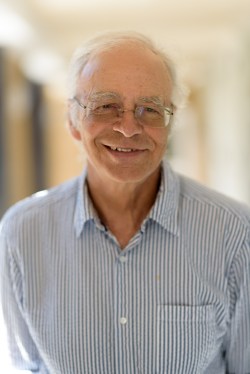
Conversation with Professor Peter Singer on Meat-Like Foods and Sentientism: Ira W. DeCamp Professor of Bioethics, Princeton University (2)
Publisher: In-Sight Publishing
Publisher Founding: March 1, 2014
Web Domain: http://www.in-sightpublishing.com
Location: Fort Langley, Township of Langley, British Columbia, Canada
Journal: In-Sight: Independent Interview-Based Journal
Journal Founding: August 2, 2012
Frequency: Three (3) Times Per Year
Review Status: Non-Peer-Reviewed
Access: Electronic/Digital & Open Access
Fees: None (Free)
Volume Numbering: 11
Issue Numbering: 3
Section: A
Theme Type: Idea
Theme Premise: “Outliers and Outsiders”
Theme Part: 28
Formal Sub-Theme: None.
Individual Publication Date: August 22, 2023
Issue Publication Date: September 1, 2023
Author(s): Scott Douglas Jacobsen
Word Count: 1,098
Image Credit: Seth Lazar
International Standard Serial Number (ISSN): 2369-6885
*Interview conducted December 16, 2022.*
*Please see the footnotes, bibliography, and citations, after the publication.*
Abstract
Prof. Singer’s biographic statement on his website says the following: “Journalists have bestowed on me the tag of “world’s most influential living philosopher.” They are probably thinking of my work on the ethics of our treatment of animals, often credited with starting the modern animal rights movement, and of the influence that my writing has had on development of effective altruism. I am also known for my controversial critique of the sanctity of life ethics in bioethics. In 2021 I was delighted to receive the Berggruen Prize for Philosophy and Culture. The citation referred to my “widely influential and intellectually rigorous work in reinvigorating utilitarianism as part of academic philosophy and as a force for change in the world.” The prize comes with $1 million which, in accordance with views I have been defending for many years, I am donating to the most effective organizations working to assist people in extreme poverty and to reduce the suffering of animals in factory farms. Several key figures in the animal movement have said that my book Animal Liberation, first published in 1975, led them to get involved in the struggle to reduce the vast amount of suffering we inflict on animals. To that end, I co-founded the Australian Federation of Animal Societies, now Animals Australia, the country’s largest and most effective animal organization. My wife, Renata, and I stopped eating meat in 1971. I am the founder of The Life You Can Save, an organization based on my book of the same name. It aims to spread my ideas about why we should be doing much more to improve the lives of people living in extreme poverty, and how we can best do this. You can view my TED talk on this topic here. My writings in this area include: the 1972 essay “Famine, Affluence, and Morality” in which I argue for donating to help the global poor; and two books that make the case for effective giving, The Life You Can Save (2009) and The Most Good You Can Do (2015). I have written, co-authored, edited or co-edited more than 50 books, including Practical Ethics, The Expanding Circle, Rethinking Life and Death, One World, The Ethics of What We Eat (with Jim Mason) and The Point of View of the Universe (with Katarzyna de Lazari-Radek. My writings have appeared in more than 25 languages. I was born in Melbourne, Australia, in 1946, and educated at the University of Melbourne and the University of Oxford. After teaching in England, the United States, and Australia, in 1999 I became Ira W. DeCamp Professor of Bioethics in the University Center for Human Values at Princeton University. I am now only teaching at Princeton for the Fall semester. I spend part of each year doing research and writing in Melbourne, so that Renata and I can spend time with our three daughters and four grandchildren. We also enjoy hiking, and I surf.” Singer discusses: non-human animal consideration; reasons people make changes in diet regarding animal welfare; and sentientism.
Keywords: Animal Liberation Now, Australia, Chinese, Japanese, octopus, oyster, Peter Singer, Princeton University, Pythagoras, Sentientism, vegan, vegetarian.
Conversation with Professor Peter Singer on Meat-Like Foods and Sentientism: Ira W. DeCamp Professor of Bioethics, Princeton University (2)
Scott Douglas Jacobsen: Things have really ramped up in the last couple decades in terms of consideration of animal welfare. Although, there is mass killing of non-human animals, certainly, in factory farms and elsewhere. However, I think with a lot of technological advancements; the conversations seem to be happening a lot more. Things just happening around meat grown through stem cells. Things of this nature. Has advancement of technology, in your opinion, changed some of the consideration of non-human animal welfare, simply for the fac that it may not be necessary to include as much suffering if you can get the same product in another manner that is more efficient?
Prof. Peter Singer: I am hopeful that cellular agriculture and plant-based analogues to meat are going to do that. I don’t think they’ve done that to a really significant scale. I think that’s largey because of cost. They are still more expensive than the standard meast products. If you buy an impossible burger or a beyond meat burger, it is going to cost you a little more than the ordinary beef burger. It may be just as good, but it is not clearly better. So, it needs to come down in price, I think, and then we need to get these other products that people are producing. There are chicken products, now, coming on the market, in Singapore anyway. They are selling chicken nuggets. I think they will start to come on the market here too. It is not as though you have been unable to nourish yourself because these high-tech meat-like products. You could always live and cheaply on plant proteins like lentils and beans of various sorts, and tofu, of course, is a product that has been around for millennia and takes a lot of different kinds of flavourings. I think it works well in a lot of dishes, particularly Chinese dishes as this is where it comes from – and Japanese dishes. So, you didn’t really need it. But some people wanted the taste in their mouth or the chewiness of meat. I hope these products will get cheaper and widely sold and eaten.
Jacobsen: To the brass tax of the considerations about making those changes, what have been, realistically, the main reasons people have made those changes in their diet or their buying patterns, purchasing patterns?
Singer: I think there are three major factors as to why people are moving away from meat in their diet. Some, like me, are primarily concerned over what we are doing to animals and you don’t want to participate in this ruthless exploitation of literally tens of millions of animals giving them nightmarish lives without any consideration for their wellbeing. That’s been one big factor. The second is we are increasingly aware of is the contribution of meat to climate change. Climate change, itself, wasn’t an issue until the mid-1980s, then it will still focused on fossil fuels for a long time. It is only in the last 10 or 20 years that people have been more aware of the role meat plays in accelerating climate change. That’s the second factor. The third factor is health, I would divide the health factor into two. On the one hand, there are people who think, “I will be healthier if I don’t eat meat”. That is certainly a factor for many, many people. You live better. You feel better. You lower risk of cancer of the digestive system and of heart disease. I think there is good evidence of all of those benefits now. That is a big factor. There is also the public health aspect of it, not just what you eat, but what other eat – because factory farms are a great place for growing new viruses. We have alreay had one major pandemic come out of a factory farm. That was the Swine Flu pandemic, which preceded the Coronavirus. It didn’t kill as many people as the Coronavrus. But it killed a lot. The big risk is the next virus to come out from animals crossing to us is that it is grown out of a factory farm with so many animals stressed together. Humans go in and out to taker the animals out to kill them or to do routine maintenance. It could be both highly contagious as Coronavirus, but much more deadly. If that happens, we will be in a very serious problem. That’s a good public health reason for wanting to not take part in factory farmed products as well.
Jacobsen: There’s a term “Sentientist” floating around. To myself, it matches, sort of, my own ethical considerations. I beieve you identify as such. How does this term – this concept – encapsulate a lot of the ethical thinking for you right now?
Singer: Well, look, the point is a sentient being, in the sense we’re using here, is on capable of suffering and feeling pain – and, hopefully, capable of experiencing pleasure and joy as well. But certainly, the capacity to feel pain is part of what it is to be a sentient being. It is a being with conscious experiences. The point of saying that you’re a sentientist is to say that you think that any being capable of feeling pain should have its interests given weight. I would say given similar weight to similar beings with similar interests. Beings that might have a similar interest. If an animal feels a certain amount of pain through – let’s say – being hit, then that is just as bad or equal to hitting a human being and causing the human being a similar amount of pain. The term “sentientist”, we talk about being vegan or vegetarian. They get termed if they eat animals or animal products. But it might not be the case that all animals are sentient. A good example of a non-sentient animal may be an oyster. Oysters have very simple nervous systems. They are unable to move away from sources of danger. So, it is arguable that they would have been less likely to evolve a capacity to feel pain, given that it wouldn’t do them much good as opposed to animals who can move away from sources of pain. So, if you are a sentientist, you might say, “I don’t eat birds and mammals, vertebrates generally. I don’t eat fish.” Perhaps, there is an invertebrate that is clearly sentient is an octopus, which is a mollusc. You might say, “If an animal is not sentient, then I don’t object to eating it, because you can’t cause it to suffer or feel pain. It doesn’t have that capacity.
Bibliography
None
Footnotes
None
Citations
American Medical Association (AMA 11th Edition): Jacobsen S. Conversation with Professor Peter Singer on Meat-Like Foods and Sentientism: Ira W. DeCamp Professor of Bioethics, Princeton University (2). August 2023; 11(3). http://www.in-sightpublishing.com/singer-2
American Psychological Association (APA 7th Edition): Jacobsen, S. (2023, August 22). Conversation with Professor Peter Singer on Meat-Like Foods and Sentientism: Ira W. DeCamp Professor of Bioethics, Princeton University (2). In-Sight Publishing. 11(3). http://www.in-sightpublishing.com/singer-2.
Brazilian National Standards (ABNT): JACOBSEN, S. Conversation with Professor Peter Singer on Meat-Like Foods and Sentientism: Ira W. DeCamp Professor of Bioethics, Princeton University (2). In-Sight: Independent Interview-Based Journal, Fort Langley, v. 11, n. 3, 2023.
Chicago/Turabian, Author-Date (17th Edition): Jacobsen, Scott. 2023. “Conversation with Professor Peter Singer on Meat-Like Foods and Sentientism: Ira W. DeCamp Professor of Bioethics, Princeton University (2).” In-Sight: Independent Interview-Based Journal 11, no. 3 (Summer). http://www.in-sightpublishing.com/singer-2.
Chicago/Turabian, Notes & Bibliography (17th Edition): Jacobsen, S “Conversation with Professor Peter Singer on Meat-Like Foods and Sentientism: Ira W. DeCamp Professor of Bioethics, Princeton University (2).” In-Sight: Independent Interview-Based Journal 11, no. 3 (August 2023).http://www.in-sightpublishing.com/singer-2.
Harvard: Jacobsen, S. (2023) ‘Conversation with Professor Peter Singer on Meat-Like Foods and Sentientism: Ira W. DeCamp Professor of Bioethics, Princeton University (2)’, In-Sight: Independent Interview-Based Journal, 11(3). <http://www.in-sightpublishing.com/singer-2>.
Harvard (Australian): Jacobsen, S 2023, ‘Conversation with Professor Peter Singer on Meat-Like Foods and Sentientism: Ira W. DeCamp Professor of Bioethics, Princeton University (2)’, In-Sight: Independent Interview-Based Journal, vol. 11, no. 3, <http://www.in-sightpublishing.com/singer-2;.
Modern Language Association (MLA, 9th Edition): Jacobsen, Scott. “Conversation with Professor Peter Singer on Meat-Like Foods and Sentientism: Ira W. DeCamp Professor of Bioethics, Princeton University (2).” In-Sight: Independent Interview-Based Journal, vo.11, no. 3, 2023,http://www.in-sightpublishing.com/singer-2.
Vancouver/ICMJE: Scott J. Conversation with Professor Peter Singer on Meat-Like Foods and Sentientism: Ira W. DeCamp Professor of Bioethics, Princeton University (2) [Internet]. 2023 Aug; 11(3). Available from: http://www.in-sightpublishing.com/singer-2.
License
In-Sight Publishing by Scott Douglas Jacobsen is licensed under a Creative Commons Attribution-NonCommercial-NoDerivatives 4.0 International License.
Based on work at www.in-sightpublishing.com.
Copyright
© Scott Douglas Jacobsen and In-Sight Publishing 2012-Present. Unauthorized use and/or duplication of this material without express and written permission from this site’s author and/or owner is strictly prohibited. Excerpts and links may be used, provided that full and clear credit is given to Scott Douglas Jacobsen, or the author(s), and In-Sight Publishing with appropriate and specific direction to the original content. All interviewees and authors copyright their material, as well, and may disseminate for their independent purposes.


